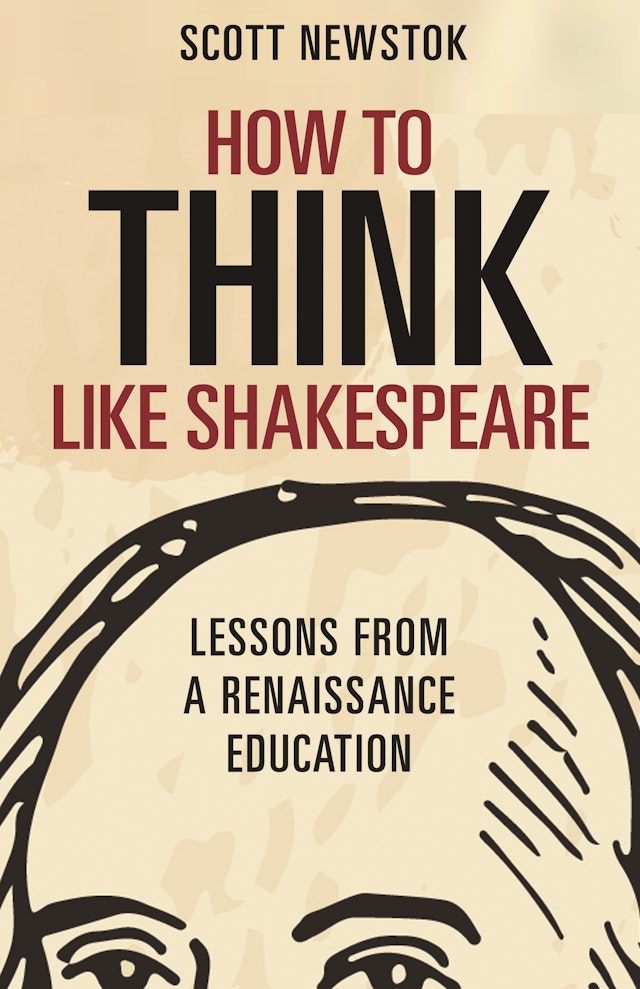
Scott Newstok’s new book, How to Think Like Shakespeare: Lessons from a Renaissance Education, makes a seemingly radical proposition: what if we returned to the teaching methods of Shakespeare’s day?
No, Newstok isn’t advocating
corporal punishment, Greek and Latin translations, or the endless rote
memorization that Shakespeare himself mocked.
However, Shakespeare’ s genius,
Newstok claims, can be nurtured, and he, professor of English and founding
director of the Pearce Shakespeare Endowment at Rhodes College in Tennessee,
knows how.
The specious-sounding treatise examines less the brain waves in
the Bard's head than the methods that shaped his education. Although
organized into fourteen short chapters (a number upon which the introduction
spends nearly two pages philosophizing), the book tends to hit you over the
head with its erudition, but that's part of its charm.
Newstok’s prodigious use of quotes,
which extends from the Table of Contents to the Index, at first caught me in a sense
of overwhelm. I'm an academic, but I was expecting this to be more in the
popular non-fiction realm. Instead, there's footnotes on every page and a realm
of thinkers from John Donne to Bob Dylan chiming in for more than their fair
share of lines. However, once you get past the jarring quantity, the charm
strikes. Newstok chooses quotes that are so delightful you could be wrapped up
in any one of them for at least the length of the chapter, and Newstok’s
glosses, especially those on Shakespeare, are tiny jewel boxes of learning
sprinkled throughout—such as this one that forms the core of his argument about
the glovemaker’s son:
The
trickster Autolycus [from The Winter’s Tale] knows so well how to size up his songs
to his duped marks that he can sell them better than any milliner can so fit
his customers with gloves [italics his].
(40)
Shakespeare, Newstok explains,
learned to think by doing, like his contemporary Christopher Marlowe, by growing
up with a craftsman father. He learned that completion of a task meant first
many steps of a process, and also that each product must be fitted to the
customer. There was no fast fashion in Shakespeare’s day. He learned to adapt
to each situation, each audience, just as I teach rhetoric today in my college
classes.
Although I think Newstok does not
acknowledge enough that many contemporary education researchers back his
propositions, and indeed, many college English professors use the methods he
advocates, his main point about the current state of K-12 education, which he
experienced firsthand with his kids in the Tennessee education system, stands.
More hands-on learning and less
teaching to the test has become a more common rallying cry these days in resistance
to Common Core. There is also the slightly incongruous fact that Newstok argues
against the trend toward technical training in colleges by extolling the trade
apprenticeships of the past, but he does have a point. Apprenticeships model
in-the-moment thinking, as opposed to rote skills learned in the classroom that
may be outdated by the time one reaches the workplace. Learning to think, as
Newstok demonstrates Shakespeare and his contemporaries as well as his Greek
and Roman intellectual ancestors did, Newstok insists, is the most important
skill one can learn in school, and Newstok shows how it can be taught using the
seemingly counterintuitive methods of Shakespeare’s day—learning creativity
through imitating others, innovation through the constraints of, say, a
fourteen-line poem, and freedom in reaction to forced canonical classroom
reading.
In his wild enthusiasm for common cultural
stock is where Newstok and I diverge, since I’ve come to realize the existing
Western literary canon largely consists of people (men) unlike me. I don’t
disagree with the idea of all common cultural stock in theory, in fact,
Shakespeare, I think, continues to be a useful cultural reference, but the
current canon in the United States is sadly skewed, and I support classroom
efforts to diversify reading. Then again, I am someone who has “benefited” from
a liberal arts education based on the previous canon, and so perhaps I cannot
say what the effects of the reading list for this next generation will be. I
put benefited in quotes above, although the benefits in some cases are quite
tangible: I’ve had high grades, graduated with an English degree magna cum
laude, and hold a master’s degree. The latter has enabled me to teach and lends
me credibility in all the work I do. However, the benefits have also subtracted
from my life. I, a white Jewish woman, have learned to internalize the
perspectives of older white Christian men. My own perspective, I am teaching
myself to learn, to advocate, to create, because I have never seen it centered
in canonical literature. Maybe that’s what Newstok means by freedom through
constraint, but it certainly puts an undue burden on those who differ most from
the central canon of authors. So, sure, let’s have a canon—but make it
balanced.
As evidenced, Newstok’s book induces
plenty of thinking, and it’s not all about Shakespeare. Although Shakespeare
forms the centerpiece of his argument and shiniest of his glosses, Newstok summons
at least four centuries' worth of thought to bolster his proposal to return to
a few of the teaching methods of Shakespeare's day. While this premise may seem
antiquated, it jibes with what many education researchers will tell
you--students need more hands-on learning and less teaching to the test. After
all, Newstok reminds us, the scientific method was born of the same system that
produced the playwriting genius. Perhaps we need more thinkers like Newstok.
Received for review from the
author. Opinions are my own.
Comments